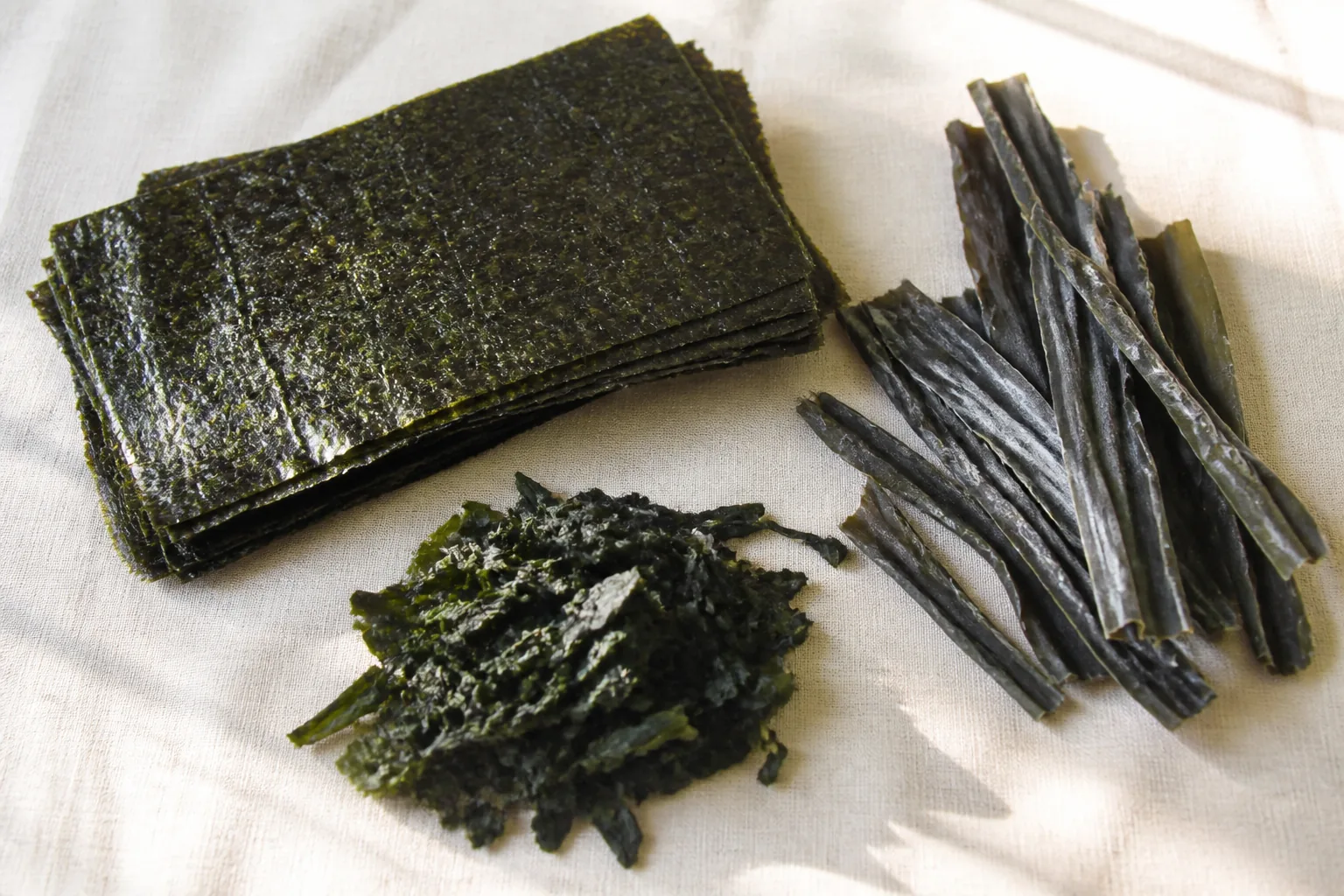
Walk into a shop with a good dried-goods aisle and the seaweed can look like a wall of dark, rustling packets that all seem to promise the same thing. They do not. Sea vegetables differ as much as leafy greens do — one is a paper-thin sheet you toast and crumble, another swells into soft green ribbons, a third is a stiff strip you drop whole into a pot and fish back out. Buying your first few is much easier once you know that you are really choosing between a handful of distinct characters, each with a job it does well. You do not need the whole wall. Four or five packets, bought small, will cover almost everything an ordinary kitchen asks of seaweed, and they will sit in the cupboard for months while you get to know them. This is a plain field guide to that first shelf: what to reach for, what each one is like, and how to tell them apart when the labels are unfamiliar.
Start with nori
If you keep only one, keep nori — the thin, near-black sheets sold in flat packets, usually pre-toasted and ready to use straight away. It is the seaweed most people have already eaten, wrapped around a rice roll, and it is the most forgiving thing to have on hand. Nori needs no soaking. You tear it, snip it with scissors, or crumble a toasted sheet between your fingers over whatever you are eating. Its flavour is mild and a little smoky, more of a savory seasoning than a vegetable in its own right.
Good nori is crisp and shatters cleanly; if a sheet folds limply, it has picked up moisture and lost its snap. Buy it in a resealable packet if you can, because it goes soft quickly once opened. A single pack lasts a long time in normal use, since a sheet or two dresses a whole meal.
Add wakame for softness
Wakame is the classic soup seaweed — the tender green strands you find floating in a bowl of miso. It is sold dried and shrunken, often as small dark flakes or short cut pieces, and it does something that surprises people the first time: a teaspoon of the dry stuff swells into a small handful once it meets water. Give it five to ten minutes in cool water and it unfurls into silky ribbons with a gentle, faintly sweet sea flavour.
Wakame is the seaweed to reach for when you want a soft texture rather than a crumbly seasoning. It slips into soups at the last minute, sits in cold salads, and mixes into cooked grains. Because it expands so much, buy a small packet first — you will use less than you expect.
Keep kombu for the pot
Kombu is the heavyweight: thick, leathery strips of kelp, often dusted with a natural pale bloom that is perfectly normal and not a sign of spoilage. You rarely eat kombu as a vegetable. Instead, you drop a piece into water or a simmering pot, let it lend its deep, rounded, savory character to the liquid, and then lift it out. A single strip does a great deal, which is why one packet lasts and lasts.
This is the seaweed that quietly improves stocks, bean pots and braises. It is worth having even if you never plan to make a formal broth, simply as a background note you can add to any pot of water you are about to cook grains or pulses in.
Two more worth knowing
Beyond the core three, two others round out a starter shelf. Dulse is a reddish-purple seaweed with a chewier bite and a more pronounced, almost savory-smoky taste; it is good torn into small pieces and toasted, or added to a salad for texture. Sea lettuce and other bright green flakes are milder and pretty scattered over finished dishes. Neither is essential on day one, but both are easy to like once the basics are familiar.
How to shop without overbuying
The temptation with a new ingredient is to buy the big bag because it seems better value. With seaweed, resist it. These are potent, long-lasting foods used in small amounts — a strip here, a pinch there — so a modest packet of each type will outlast your enthusiasm to experiment. Small packets also let you try several kinds for the price of one large one, which is the fastest way to learn what you actually reach for.
Check the packets for a clean, sea-fresh smell rather than anything musty, and favour ones that are whole and unbroken over bags of dust. Beyond that, there is not much to get wrong. Bring home your four or five, decant them into jars at home, and you have a starter set that will quietly earn its shelf space for a long time to come.